
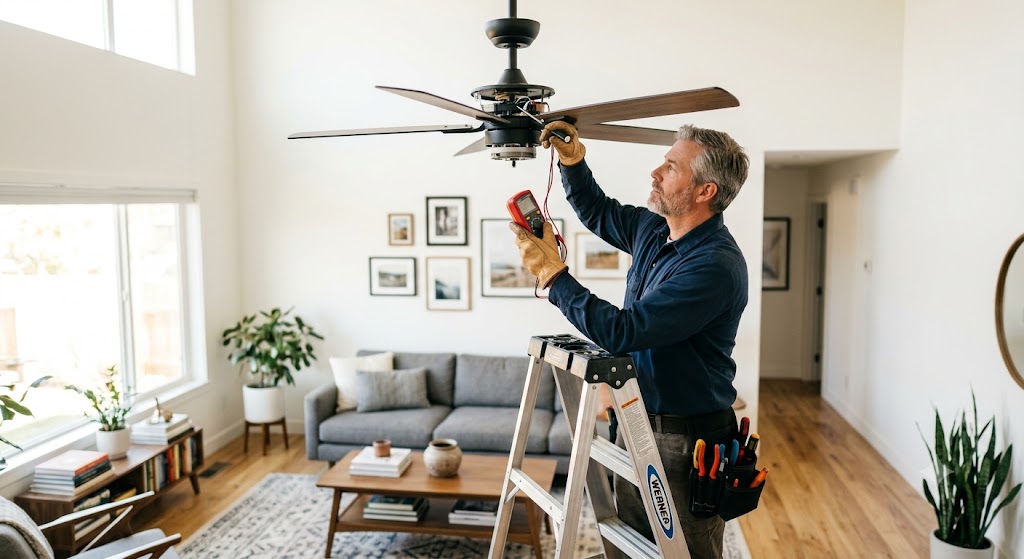
There are few things more frustrating on a hot Los Angeles evening than flipping the switch and getting nothing but silence from your ceiling fan. Maybe it hums but won’t spin. Maybe it wobbles like it’s about to fall out of the ceiling. Or maybe it just… stopped, with no warning at all.
The good news: most ceiling fan problems fall into a short list of common causes, and several of them are things you can safely check yourself before calling in a professional. Here are the seven issues we see most often, what causes them, and how to know when it’s time to bring in an electrician for ceiling fan repair instead of troubleshooting alone.
1. The Fan Won’t Turn On At All
This is the most common complaint, and it usually comes down to one of three things: a tripped breaker, a burned-out capacitor, or a loose wiring connection at the fan itself.
Start simple – check your breaker panel to see if the circuit for that room has tripped. If it has, reset it once and see if the fan comes back on. If it trips again immediately, stop. A breaker that won’t hold usually means there’s a short somewhere in the wiring, and that’s not a DIY fix. Repeated tripping is a strong signal you need a wiring fault diagnosis to find out exactly where the short is coming from before it causes bigger damage.
If the breaker is fine, the issue is often a failed capacitor inside the fan’s motor housing – a small component that gets worn out over years of use, especially in fans that run constantly through LA’s warmer months.
2. The Fan Hums But Doesn’t Spin
If you hear the motor running but the blades aren’t moving, the capacitor is almost always the culprit. Capacitors provide the initial jolt of power needed to get the blades spinning; when they fail, the motor still draws power and hums, but there’s nothing pushing the blades into motion.
This is a repair that requires opening the fan housing and testing electrical components, which means it’s safer left to a licensed pro rather than attempted with the power still connected.
3. The Fan Wobbles or Shakes
A wobbling fan is annoying, but it’s rarely an electrical issue on its own – it’s almost always mechanical. The most common causes are:
- Blades that have warped slightly from heat or humidity
- A mounting bracket that has loosened over time
- Uneven blade weight (dust build-up on one blade but not others)
- The fan not being properly secured to an electrical box rated for ceiling fan weight
That last point matters more than most homeowners realize. Ceiling fans are heavier and generate more torque than a standard light fixture, and if yours was installed on a box that wasn’t rated for it, wobbling isn’t just annoying – it’s a safety hazard. If you’re not sure what your fan is mounted to, this is worth having checked before the fixture works itself loose.
4. The Fan Runs But the Light Doesn’t Work
When the fan spins fine but the attached light kit won’t turn on, the issue is usually isolated to that specific circuit within the fixture – often a blown bulb, a loose bulb connection, or a failed pull-chain switch. But if you’ve already ruled those out, the next most common cause is a bad connection at the wall switch controlling the light, especially in older LA homes where switches and dimmers weren’t originally designed for ceiling fan light kits.
Using a dimmer switch not rated for fan-compatible LED bulbs is a surprisingly common cause of this exact problem, and it’s a quick fix once identified.
5. The Fan Only Works on Certain Speeds
If your fan runs fine on high but does nothing (or barely moves) on low and medium, this points directly to a failing capacitor or a worn-out speed control switch inside the fan. Multi-speed fans use the capacitor to regulate voltage across different speed settings, so as it degrades, the lower speeds – which need more precise voltage control – tend to fail first.
This is a repair, not a replace-the-whole-fan situation in most cases, and it’s usually quick for a licensed electrician to diagnose and fix.
6. The Fan Trips the Breaker When Turned On
If your fan trips the breaker the moment you switch it on, you’re likely dealing with a short circuit in the motor windings or in the wiring connecting the fan to your electrical system. This is different from a fan that simply won’t start – this is an active safety issue.
Don’t keep resetting the breaker and trying again. Repeatedly forcing power through a short can damage wiring further and, in worst cases, create a fire risk. This is exactly the kind of issue covered under GFCI outlet replacement and broader circuit safety work – if your fan is on a circuit that should have GFCI protection and doesn’t, that’s worth addressing at the same time as the fan repair.
7. The Fan Is Old and Repairs Keep Adding Up
Sometimes the honest answer isn’t “what’s broken” but “is this fan worth fixing.” Ceiling fans typically last 10+ years, but motors, capacitors, and switches all wear out with age and heavy use – which is common in Los Angeles homes that run fans nearly year-round.
If you’re on your second or third repair for the same fixture, or if your electrical panel is older and struggling to keep up with modern fan and lighting loads, it may be worth having your setup evaluated more broadly. A panel box upgrade isn’t usually about the fan itself, but in older homes it’s often the underlying reason multiple fixtures act up over time.
When to Call an Electrician vs. DIY
Checking a breaker, cleaning dusty blades, or tightening a visibly loose mounting screw are reasonable DIY tasks. Anything involving opening the motor housing, replacing a capacitor, rewiring a switch, or diagnosing repeated breaker trips should go to a licensed electrician. Ceiling fans combine electrical risk with the added danger of a heavy fixture mounted overhead – not a great combination for trial and error.
If your fan issue happens outside normal business hours, or you’re dealing with sparking, burning smells, or a breaker that won’t reset, that’s not a wait-until-Monday problem. Our 24/7 emergency callout service covers exactly this kind of situation across Los Angeles.
Get Your Ceiling Fan Fixed Right the First Time
A ceiling fan that’s humming, wobbling, or refusing to turn on isn’t something to ignore – left alone, most of these issues get worse, not better, and a few of them carry real electrical safety risks. If you’ve gone through this list and you’re still not sure what’s wrong, or you’d rather not risk it, our licensed electricians can diagnose and repair the issue quickly.
Contact us today for a free quote, or call now for same-day service anywhere in Los Angeles.
Leave a Reply