Los Angeles is a city of beautiful old bones. Craftsman bungalows in Highland Park, Spanish Revival homes in Los Feliz, and mid-century ranches in Sherman Oaks all give LA its unmistakable character. But that charm comes with a catch: a lot of these homes still have electrical systems that were installed decades before smartphones, central air, or even microwaves existed.
If you’ve bought or inherited an older home in Los Angeles, there’s a good chance you’ve heard the terms “knob-and-tube wiring” or “aluminum wiring” thrown around by home inspectors, insurance agents, or your electrician. Both were standard practice in their day. Neither is considered safe by today’s standards. Here’s what homeowners need to know, why it matters more in LA specifically, and what your options are.
What Is Knob-and-Tube Wiring?
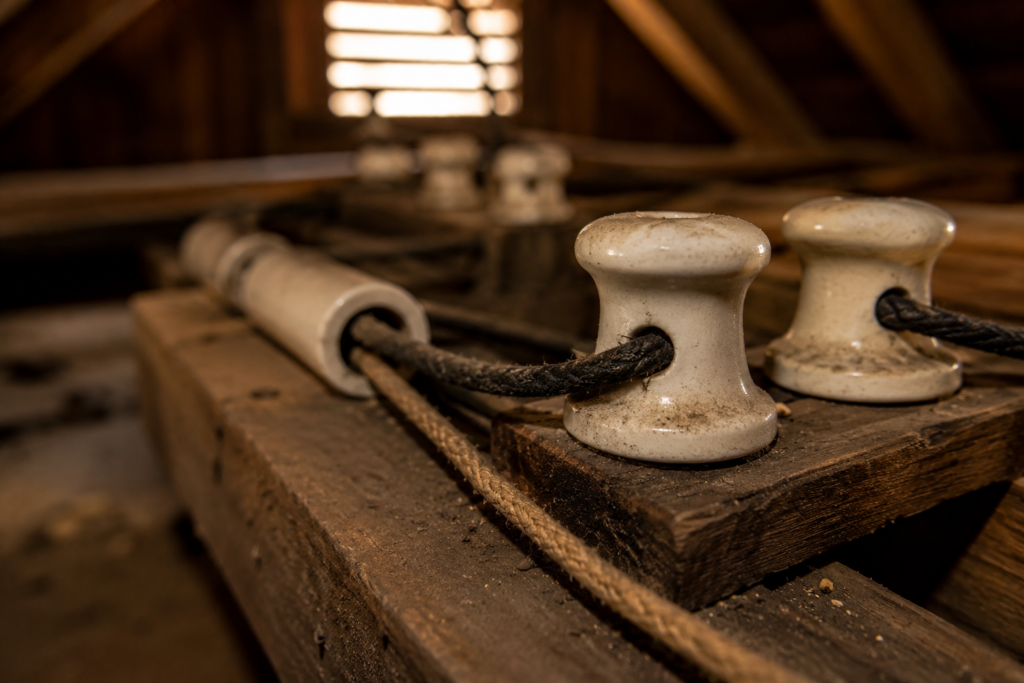
Knob-and-tube (K&T) wiring was the standard residential wiring method in the United States from roughly the 1880s through the 1940s. It gets its name from the ceramic knobs that anchor wires to framing and the ceramic tubes that protect wires as they pass through joists and studs.
If your LA home was built before 1950 – think parts of Angelino Heights, West Adams, or Boyle Heights – there’s a real chance some of the original knob-and-tube wiring is still in the walls, even if later renovations added modern circuits alongside it.
On its own, knob-and-tube wiring wasn’t badly designed for its era. The problem is that it was engineered for a world with far fewer electrical demands. It has no ground wire, which means no protection against shock in the event of a fault. The rubber and cloth insulation that coats the wires becomes brittle and cracks with age, exposing bare copper. And it was never designed to handle the electrical load of a modern household running air conditioning, EV chargers, home theaters, and a dozen phone chargers at once.
What Is Aluminum Wiring?
Aluminum branch-circuit wiring had a shorter but still significant run, mostly installed in homes built between the mid-1960s and mid-1970s during a copper shortage. If your home falls in that build window – common in parts of the San Fernando Valley, like Reseda or Van Nuys – aluminum wiring is worth investigating.
Aluminum itself isn’t inherently dangerous, but it behaves very differently from copper. It expands and contracts more with temperature changes, which loosens connections at outlets and switches over time. Aluminum also oxidizes when exposed to air, and that oxide layer isn’t a good conductor, which increases resistance at connection points. The result is a wiring system prone to developing hot spots at outlets, switches, and light fixtures – a well-documented fire risk that insurance companies take seriously.
Why This Matters Especially in Los Angeles
A few things make this a particularly LA-relevant issue:
LA’s housing stock skews old:- Whole swaths of the city were built out during the exact decades when knob-and-tube and aluminum wiring were standard. Unlike newer suburban development elsewhere in the country, much of LA’s charm is tied up in homes that predate modern electrical code entirely.
Renovation culture runs hot here:- Open-concept kitchen remodels, ADU conversions, and add-a-bedroom projects are constant in this city, and every one of them adds load to a system that may not have been upgraded since Eisenhower was president.
Insurance companies are paying closer attention:- Many insurers in California now require an inspection – or outright decline coverage or charge higher premiums – for homes with active knob-and-tube wiring. If you’re refinancing, selling, or shopping for a new policy, this can become a real financial issue, not just a safety one.
Wildfire-conscious fire codes:- With LA’s elevated wildfire risk profile, both insurers and inspectors are increasingly strict about anything that raises ignition risk, and degraded old wiring is high on that list.
Warning Signs You Shouldn’t Ignore
You don’t need to be an electrician to spot red flags. Watch for:
- Warm or discolored outlet and switch covers
- Frequent flickering lights, especially when appliances kick on
- A persistent burning smell with no clear source
- Breakers or fuses that trip repeatedly
- Outlets that only accept two-prong plugs throughout the house
- Visible cloth-wrapped wiring in the attic or basement
Any of these on their own is a reason to get a professional opinion. Several together mean it’s time to stop waiting.
Is It Safe to Leave As-Is?
Knob-and-tube wiring that’s untouched, unmodified, and not overloaded can technically keep functioning for years without incident. But “hasn’t failed yet” isn’t the same as “safe.” The insulation only gets more brittle with time, homeowners rarely know the full history of what’s been spliced or added over the decades, and most K&T systems were never designed to be buried in modern insulation, which is now common in energy-efficient retrofits – a combination that traps heat and raises fire risk.
Aluminum wiring carries similar logic. A properly maintained aluminum system with the right anti-oxidant compounds and connectors can be relatively stable, but most homes were never professionally maintained to that standard, and loose connections tend to go unnoticed until something fails.
The honest answer most licensed electricians will give you: it’s a risk that compounds over time, and it’s one worth addressing before it addresses itself in the form of an outage or something worse.
What Are Your Options?
- Full rewire:- The most thorough fix, replacing old wiring with modern copper NM cable throughout the home. This is the gold standard for older LA homes, especially ahead of a major renovation.
- Partial rewire with panel upgrade:- For homes where a full rewire isn’t in the budget right away, prioritizing high-load areas (kitchen, laundry, home office) along with a panel box upgrade can meaningfully reduce risk.
- AlumiConn or COPALUM connectors for aluminum wiring:- A recognized, code-approved method to join aluminum wiring to copper pigtails at outlets and switches without a full rewire.
- Fuse box conversion:- If your home still runs on an old fuse panel rather than a breaker panel, a fuse box conversion is often a necessary companion step to any wiring upgrade.
Whatever path you choose, the first step is always the same: a proper wiring fault diagnosis from a licensed electrician who can open up outlets and panels, trace what’s actually in your walls, and give you a realistic picture of the scope and cost.
Don’t Guess – Get It Checked
If you own a pre-1950 home anywhere from Echo Park to South Pasadena, or a mid-century property in the Studio City area, it’s worth having a licensed electrician take a look, even if nothing seems obviously wrong. Combined with a working, properly wired smoke alarm system, an inspection is one of the cheapest forms of insurance you can buy for an older LA home.
For homeowners planning bigger changes – like adding an EV charger or handling a residential wiring emergency – an outdated electrical backbone should be the first thing addressed, not an afterthought. You can also read more in our guide on essential electrical upgrades for safer LA properties.
Electrician Los Angeles has spent over a decade working in homes across LA County’s older neighborhoods, from Craftsman bungalows to mid-century ranches. If you’re not sure what’s behind your walls, contact us for an inspection, or call (213) 772-3894 – we’re available 24/7 for anything that can’t wait until morning.
Leave a Reply